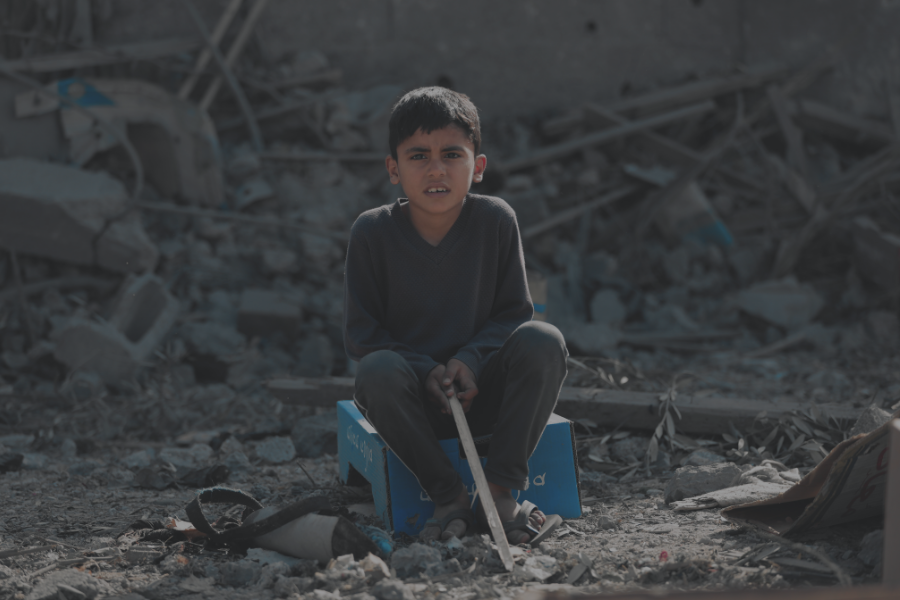
For some reason, logically unfathomable to me, the war between Palestine and Israel has support on both sides. This is probably because we have been told that this is a conflict that has been happening for thousands of years… except it hasn’t. Israel frames this as a religious conflict that has existed since antiquity. But the religion they claim to be in conflict with did not exist in antiquity. Islam emerged in the seventh century CE. The framing is a rhetorical cover.
And anyone who has been paying attention to actual reports and on-the-ground journalists knows that very little of this conflict centers around religious differences. Now, if you only read headlines, perhaps one wouldn’t know this, which is why reading and researching on your own is so, so important. Tens of thousands of people’s lives rely on public opinion to be educated, not propagandized. Because when we portray this as, and understand this to be, a conflict that has been occurring since the beginning of time and is based solely on belief and theology, we turn it into something unfixable and unmanageable.
There is certainly a history here, going back to when Palestine was technically still part of the Ottoman Empire pre-WWI, and Great Britain announced in the Balfour Declaration that they would grant those in the Zionist Federation of Great Britain and Ireland who believed in revisionist and religious Zionism a home in Palestine. This is odd, since Great Britain had no ownership of that land, but since when has that stopped the Crown before? There’s pre-WW1, WWII, and post-WWII history there, and there is no changing history, hypothetically. At least it’s supposed to be that way, but it depends on who’s writing your history textbooks.
The United Nations split Palestine into Palestinian and Jewish states in their Partition Plan a couple of years after WWII ended. Then pretty soon after, the 1948 Arab-Israeli war broke out. Israel won this conflict and so gained another third of Palestinian land than they had in the original UN agreement. Palestinians had to flee, practically becoming stateless, while Israel saw this as the beginning of their State. Then again in 1967, a war that lasted six days, rightfully called the Six-Days War, occurred. Israel won again and gained control over more Palestinian land, including the West Bank and the Gaza Strip. Areas anyone on social media is familiar with today. But the UN wrote a resolution for peace, requiring Israel to give back the land it had acquired during that war and recognizing the right of both an Israeli and a Palestinian state to exist. Yeah, that didn’t happen. There have been forms of conflict since between Arabs and Israelis and Palestinians.
Also, in case you don’t know: not all Muslims are Arab, not all Arabs are Muslims, not all Arabs are Palestinian, and not all Palestinians are Muslim! Palestinian is an ethnic identity of those who have historically lived in Palestine. They are an ethnic group.
Israel began sending Jewish settlers into Gaza and the West Bank, which is illegal under international law, mind you, but Israel says that’s not so. Israel does not recognize Palestine as a real state. Which is insane, since it was there long before the state of Israel existed.
This led to some late 1980s boycotting and protesting of Israeli products, services, and taxes, which the Israeli armed forces put to an end real quick with violence. During this first intifada, Hamas was founded and launched its first suicide bombing against Israel in the early 1990s as retaliation.
Hamas. Now this part is particularly important to understand from both sides, because Hamas has been the reason or excuse, depending on your persuasion, for Israel’s genocide against Palestinians. Hamas gains support 1. because of its military, but 2. because of its welfare projects in Gaza for the Palestinian people. They built schools, health clinics, and mosques.
One benefit of the First Intifada was that it opened up peace talks between Israel and Palestine, called the Oslo Accords. Peace talks sound great, but there were still a lot of issues to agree on, and they couldn’t agree, so it never happened.
Some back-and-forth happened, including the Second Intifada, where thousands of lives were lost on both sides, though over 3/4 of the deaths can be attributed to Palestinian lives. Israelis began building a wall around Gaza in defense of their civilians, and in doing so did not honor the earlier-decided borders, but built the wall to give themselves more land, including the settlements that the Jewish people had built in Palestine. And after what the Palestinians viewed as an illegal land grab, Hamas gained political power in Palestine and started making governing decisions alongside the Palestinian Parliament.
Hamas has sent attacks into Israel; Israel has sent invasion attacks into Palestine. A response that international legal bodies have documented as collective punishment of an occupied civilian population under the cover of self-defense. In this process, thousands of civilians have lost their homes, their loved ones, and their lives. The Palestinian people now have no state, and what they do have is under violent military occupation.
In the 2010s, this was border clashes and occupation, but now, in the 2020s, it has turned into a devastating war that has displaced and taken tens of thousands of lives.
Israeli Zionists believe they are the rightful owners of that land. They believe they are simply returning and reclaiming what is theirs.
As an American, this often makes me think of Native Americans, or Indigenous Americans, deciding to reclaim USA land as their own. They would have the same claim the Israelis are making, but the American government and people would never allow that. Yet somehow, those same US citizens and government officials, who we can surmise pretty confidently wouldn’t give up their rights to the land, expect the Palestinians to do so.
This tumultuous past, which I have summarized and condensed quite a bit for understanding’s sake, is important to understand how we got here. It’s also important to note that some of these facts are genuinely debated based on who you’re reading/listening to, who wrote the reports, and what their end-game was. Regardless, now we’re here, today, in 2026. The crimes that are being committed against humanity today are more serious than a debated past that’s being used to dignify mass murder in the present. Ethnic cleansing can have no true justification. And no matter what the survivors of this time in history say in the future, every single one of us worldwide watched the last few years happen on our screens. We watched as men, women, and children have starved to death. We watched people climb from the rubble on livestreams on TikTok. We watched parents and siblings carrying their dead loved ones. We watched Medic crews get bombed while trying to save the injured. We watched children shot down while running for bags of food.
We saw it all. There’s no denying that.
I can vividly remember seeing a video of a Palestinian man carrying his beheaded son, walking away from the rubble. At the time I watched it, the video had not been blurred or censored. I vomited.
That physical reaction was caused by a twenty-second clip on my phone, miles of land and an ocean away. If ordinary people watching short clips that have been allowed on our algorithms are physically sick from what they are seeing, what does that mean that institutions (which are also always run by people) that have more access to the truth and the power to make actionable change are more concerned with carefully crafting statements to appease the public?
I know I’m not the only one who has gotten sick or felt absolute fear and despair at seeing what we’re willing to allow one group of humans to do to another. So how does that intrinsic, human response connect with the international community’s lack of acknowledgment and action?
We scroll past and go on with our days, not because we’re monsters but because we have been desensitized to these atrocities. Our nervous systems weren’t designed to witness mega-scale destruction and violence on our screens every single day. This desensitization isn’t the fault of individuals but of a system built by the dynamic between modern tech and psychological impact that benefits institutions whose inaction depends on the public being exhausted and disengaged.
These institutions have gone further than desensitizing us to the issues at hand; they’ve also conflated two issues to keep people confused on which side is morally right. There are those who confuse anti-genocide with antisemitism, which are two completely different issues. If someone speaks out against the genocide in Gaza and is then labeled an antisemite, they may be less likely to continue speaking out. Because they are not an antisemite. That individual who is against the murder of Palestinians is also against hate against the Jewish people.
The conflation of an anti-genocide position with antisemitism is one of the most effective rhetorical tools being used to suppress political engagement with what is happening in Gaza, and it deserves direct examination by all of us. Opposition to a government’s military campaign is not antisemitism, even if that government is Israeli. Supporting Palestinian rights is not antisemitism. In fact, these positions are held by Jewish people around the world, including in Israel itself. Jewish scholars, Jewish activists, Jewish politicians, and Jewish organizations have spoken clearly and publicly against the violence being committed in Gaza and South Lebanon. You want proof and examples: Jewish Voice for Peace. IfNotNow. The thousands of Jewish protesters arrested at demonstrations across the United States. The Israeli military refuseniks. Falsely comparing criticism of Israeli government policy with antisemitism is a rhetorical strategy designed to make political opposition to specific military actions appear as hatred of an entire people, which it is not. This strategy works by silencing critics by associating them with one of the most serious moral charges available in contemporary political discourse following WWII.
We can talk about these issues, but we also need to discuss what this label of genocide really means. Yes, people and organizations can label an act as a genocide, but who cares? Is it just a word? Well, yes and no.
The Genocide Convention of 1948 defines genocide as acts committed with intent to destroy in whole or in part, a national, ethnical, racial, or religious group. That Convention also outlines what signatory states (those who signed on to enforce the Convention) are required to do when a genocide has been publicly and legally established. Let’s look at the first five articles of the Convention:
Article I
The Contracting Parties confirm that genocide, whether committed in time of peace or in time of war, is a crime under international law which they undertake to prevent and to punish.
Article II
In the present Convention, genocide means any of the following acts committed with intent to destroy, in whole or in part, a national, ethnical, racial or religious group, as such:
(a) Killing members of the group;
(b) Causing serious bodily or mental harm to members of the group;
(c) Deliberately inflicting on the group conditions of life calculated to bring about its physical destruction in whole or in part;
(d) Imposing measures intended to prevent births within the group;
(e) Forcibly transferring children of the group to another group.
Article III
The following acts shall be punishable:
(a) Genocide;
(b) Conspiracy to commit genocide;
(c) Direct and public incitement to commit genocide;
(d) Attempt to commit genocide;
(e) Complicity in genocide.
Article IV
Persons committing genocide or any of the other acts enumerated in Article III shall be punished, whether they are constitutionally responsible rulers, public officials or private individuals.
Article V
The Contracting Parties undertake to enact, in accordance with their respective Constitutions, the necessary legislation to give effect to the provisions of the present Convention, and, in particular, to provide effective penalties for persons guilty of genocide or any of the other acts enumerated in article III.
Now we have a solid, indisputable, working definition of what genocide really is in the eyes of international law.
The documented evidence from Gaza includes mass civilian casualties at a scale and rate that exceed most modern conflicts, the deliberate targeting of hospitals, schools, and civilian infrastructure, the blocking of food, water, and medicine to a civilian population, statements by Israeli government officials that legal scholars have identified as evidence of genocidal intent, and the forced displacement of the majority of Gaza's population. In fact, we all saw these things happen on our phones, on our TV screens. It is indisputable that these acts occurred.
In January 2024, South Africa brought the case of genocide in Gaza before the International Court of Justice (ICJ). The ICJ has yet to issue a final ruling on the matter of genocide despite overwhelming video evidence and mass casualty data. It has, however, found the claims plausible enough to require Israel to take immediate action to prevent further harm, as outlined in its provisional measures order.
What’s happening in Gaza isn’t new, as in it didn’t just start a couple of years ago when we all started seeing it on our algorithms in the US. There are decades of context behind what we’re seeing now, what we’ve gotten used to witnessing.
I recently read Leila Khaled’s My People Shall Live, where she explains the context a lot of people are missing. The dispossession of Palestinians began in 1948 with Nakba. This was when the establishment of the state of Israel involved the forced displacement of approximately 700,000 Palestinians from their homes, the destruction of over 500 Palestinian villages, and the creation of a refugee population that now numbers in the millions across multiple generations. Then, the occupation of the West Bank and Gaza began in 1967, and the siege of Gaza began in 2007. While the ICJ hasn’t publicly ruled on genocide, it has publicly documented the Israeli government’s settlement in the West Bank as a violation of international law. The UN Security Council and many other international legal bodies agreed.
What we have seen since 2023 is the most visibly violent stage in this militant process that has been ongoing for seven decades. And we are already starting to forget it.
On top of that, this essay only scratches the surface.
A deeper discussion has to be had about the actual land and what happens to it when all of this is over. Who will live there? Who will resettle? Will the ICJ allow this to be done on top of mass burial grounds?
The physical obliteration of Palestinian civilian infrastructure, homes, hospitals, universities, archives, mosques, and cultural institutions makes that land and those communities impossible for Palestinians to return to. Deliberate targeting of cultural and historical sites erases history, and it erases a people. This militant strategy followed the exact pattern that international criminal law recognizes as a war crime.
While there are institutions that insist on denying the reality of what is happening, a rise in independent journalists and civilian archivists has occurred. In my opinion? Proof that an individual can make a difference. More journalists have been killed in Gaza than in any conflict in recorded history in a comparable time period, and yet people continue to fight for the truth of what they’ve seen. The people risking their lives and livelihoods to create an archive of this atrocity understand that the frontline of impunity is the erasure of evidence. Every document, every photo, every written statement is potential evidence for future proceedings. While genocide hasn’t been ruled by the ICJ as of September 2026, that does not mean it will stay that way. This data will matter in courts that have not yet convened.
We are the world that watched and did nothing during the first 70 years of this attack against Palestinian’s right to exist and their right to their land. We are the world that watched the mass murder of thousands and did nothing as a whole. Why is that? Why is it incumbent upon the individual to act in a situation where international courts should?
Unfortunately, there is strategic interest for governments like the US in maintaining certain alliances with other governments. Those who donate to political groups worldwide get to choose who they support, and there are significant pro-Israel constituencies who influence major parties with money. The arms industry profits off this genocide. International institutions also have limited power when those States under them don’t benefit from an act. There are nuances to how international courts can actually function and deploy action. Those who have the power to stop what’s happening benefit from the genocide, and, for some reason, humanity loses its soul when it comes to power. It’s how it works in the international and national system, and it’s been happening throughout all of history.
It is our individual duty to not let ourselves be desensitized to violence, to not let our minds “other” a group of people. We live in the age of social media where information and news is shared between millions of people who watch the same things alone in their homes. It’s easy to feel alone behind a screen, but there are thousands of people and plenty of organizations who care and stand for international communities who need it.
The gap in understanding by publics and individuals is a strategic political choice, which is why we must educate ourselves on legal and political definitions of what is going on. On acknowledging that the archive and evidence exist. On realizing that individuals can make an impact when they communicate and work together. There is no longer an excuse to not know, to not understand. To be ignorant of the truth is a failure of will.
The people paying for that failure are the ones at the bottom of the rubble waiting for the world to decide that what is happening to them matters enough to name and stop.
This is one of the greatest geopolitical issues of our time, so if this interests you, I implore you to do your own research. Never take one source’s word for it. This situation is too complex, too important. I’d like to include some sources to look into to learn for yourself: