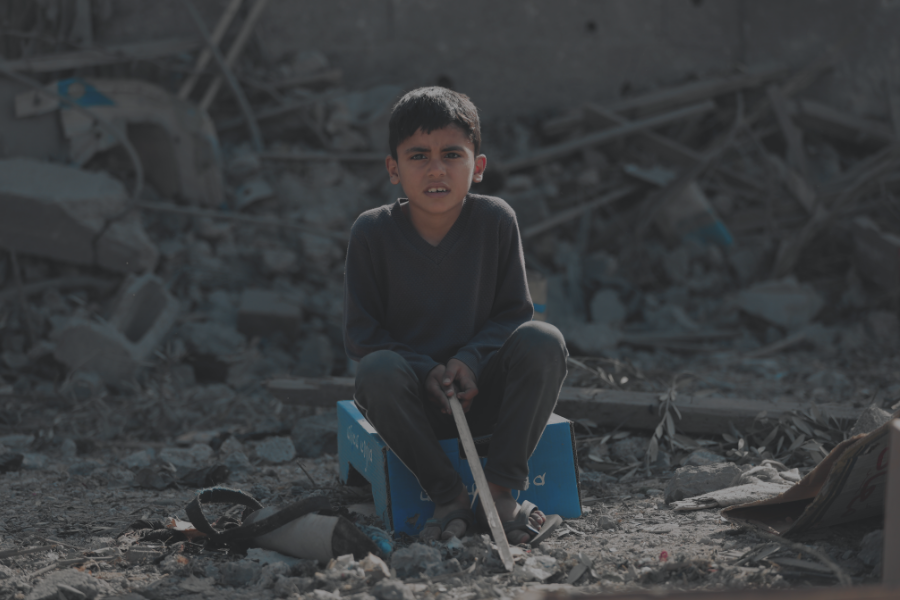
On October 19, 2026, President Donald Trump told reporters, “Paris is going to be a Muslim city very soon.” This was in response to the riots currently happening in France, and according to a video posted by Firstpost, Trump concluded it was President Emmanuel Macron's fault for letting too many people in from “all over the world”. Now, I’m all about thinking critically and criticizing the social realities that live within all organized patriarchal religions, but that’s not what was happening here. This strategically allocated blame to a specific type of migrant by a politician not only pushes a particular agenda, but it totally ignores the real purpose of the protests, now riots, which started as students demanding better school conditions. Its purpose has since broadened to include the high cost of living, fuel prices, and the French government’s austerity measures, which are policies that reduce public spending through budget cuts and tax increases. And while American media isn’t the be-all and end-all, why are top U.S. officials trying to place blame where they are?
The BBC and several other news sources have reported that the protests in France turned more violent and destructive after a 15-year-old protester was seriously injured by a police stun grenade. As we know, there are now riots in Paris, Lyon, and Marseille. Cars are burning. Businesses are being destroyed. Historical artifacts are being defaced because the French people are demanding a higher quality of life. And while the U.S. President blames “the Muslims”, I’d like to highlight a more nuanced and honest perspective from someone who was there a few weeks ago.
I was in Paris in mid September 2026 as a wide-eyed tourist visiting the city for the first time. I didn’t have a whole lot of expectations, other than I was told by many Americans who had never been to France that French people are mean. I found quite the opposite. Everyone was extremely welcoming and respectful. No one scoffed at my terrible accent, as I definitely butchered my pronunciation of simple words. I’m pretty sure they appreciated that I didn’t immediately assume everyone would speak English to me.
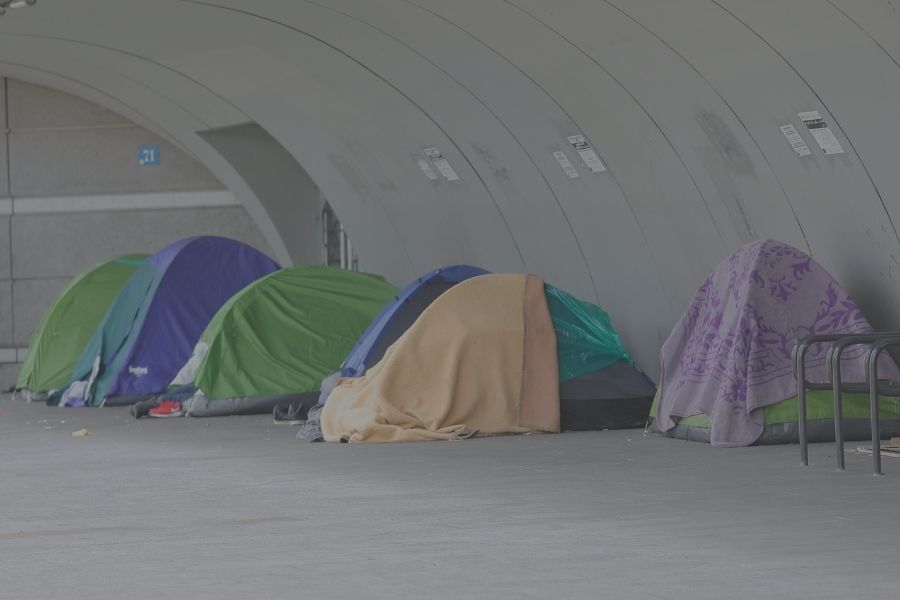
I had purchased my first French Vogue in Morlaix the day before my train arrived in Paris. It was this very magazine that sparked conversation between my seatmate and me on the four-hour train. She had lived in Paris all her life, but explained it was not the same city today as it was when she was a young girl. And while I loved everywhere else I had been in France, I was feeling apprehensive as my Uber took me to my hostel. As we drove past Metro Line 2 near La Chapelle or Stalingrad, I saw my first French “tent-city”.
Now, I don’t know if the French use the same terminology as we do here in America for groups of homeless people living under tarps together, but when I worked with the homeless in 2016, everyone referred to these hodgepodge communities as tent-cities. They could be found in thickets of trees, on the edge of town, or along highways in the U.S. But here, in Paris, people were living huddled under infrastructure in the middle of one of the wealthiest and most visited cities in the world.
My driver had been welcoming and chatty for most of my drive and pointed out what I had obviously seen, explaining that a lot of people from the Middle East and North Africa had been flowing into France to escape the turmoil happening in their homes. He told me it was getting more crowded by the day. Resources were limited. People were angry. Another driver I had a few days later, an extremely friendly and talkative man from Nigeria, explained that it was getting exponentially worse. He had lived there with his mom since he was eight, and the attitude towards foreigners was shifting as things worsened.
But what my Uber drivers, hostel workers, the very kind woman I sat by on the train, and I all saw was not a migration crisis.
This is a structural crisis, an issue with how these Western governments function around reception of asylum seekers. The people are there; they’ve been there, and they aren’t going anywhere. The real question becomes what the legal systems these societies function within are doing about it.
And just as with the quality of schools, access to affordable homes, and the cost to everyday Parisians, the government was not acting satisfactorily in the eyes of the people. And while every Parisian I talked to about the issue mentioned that the rise in immigration was an issue, it was more about the government’s handling of the issue than directed at the individual migrants themselves. Of course, I can’t speak for everyone, only the conversations I had and the things I personally witnessed. I am an American tourist after all… what business do I have speaking on this? What do I know?
Well, it seems I know a bit more than my country’s President. Because if I ask the friends I made in France (too small a sample, I know, which is why the essay doesn’t end here), they do not call the current crisis a “Muslim crisis” but a government one. Which, interestingly enough, is a similar sentiment shared by many Americans about their own country.
This is why it is so important to look in tandem at who is making a claim, what they intend by it, and the context of the situation.
As of May 2026, roughly four months before the current protests started, about 800 migrants were living in the last and largest authority-tolerated encampment (tent-city) in Paris. These migrants' nationalities have been documented as Afghan, Sudanese, Eritrean, Ethiopian, and Chadian–all people who have been arriving in France since 2016 as asylum seekers and didn’t meet a welcome committee. In 2026, reporting from the camp still describes Afghan and Sudanese migrants. Paris’ new mayor as of March 2026, Emmanuel Grégoire, promised solutions to the Parisian people that May. But what solutions are those? Are they to perpetuate the same recurring cycle that has been happening since 2015? Tent-city/encampments: authorities clear them, they pop up again somewhere else, authorities clear that location, they pop up again, and so on.
According to the Guardian and InfoMigrants, between 2015 and 2019, over 50,000 migrants were evacuated from Paris street encampments by Paris police. But this cleansing of the streets doesn’t last long, because there is no infrastructure in place to actually solve the problem of this many people having to live on the streets. They end up right where they started.
The state has also been accused of “social cleansing” when it’s convenient, such as around the 2024 Olympics in Paris. Le Revers de la Médaille, a coalition of more than 100 organizations, reported that 19,526 people were forcibly displaced from tent camps and other informal housing in the Paris region in preparation for tourist influx that would accompany the 2024 Olympics. Some people were evicted more than once and counted more than once, and the regional prefect denies the evictions were tied to the Games, saying everyone displaced was offered alternative housing.
In January of 2026, a count of people on Paris streets showed a 10 percent increase from the previous year alone. So where are these people coming from and why?
The people living under the metro didn’t appear out of thin air. They came from Afghanistan, Sudan, Eritrea, and other countries shaped by war, authoritarian rule, and colonial legacies that Western imperialist powers helped create or worsen. In Afghanistan, that means two decades of US-led war. In Sudan, it means British colonial rule that, many historians argue, deepened the divisions behind today’s conflict. France is not innocent here either.
Like Great Britain, Spain, Portugal, and the U.S., it was an imperial power in the 19th and 20th centuries, building the world’s second-largest colonial empire, which reached across North and West Africa, Southeast Asia, the Middle East, and the Pacific. French remains an official language in many of those countries, and France keeps significant economic and political ties there. Resources were stolen, cultures were diminished, and many of those societies have struggled with upheaval since.
Today, Western governments, like that of France, lay blame on mass migration stemming from issues their predecessors caused in asylum-seekers’ homelands. Western governments are not only implicated in the lack of care and governance of their own people, but of those now fleeing to them for help. This is not a France-only problem, but current events in France give us a digestible understanding of what is happening on a larger scale across the Western world.
This is partially why asylum laws were established, not only from a humanitarian point of view, but also from a logistical one. France’s asylum system is governed by two bodies: the French Office for the Protection of Refugees and Stateless Persons (OFPRA) and the National Court of Asylum (CNDA). The first makes immediate decisions, and the latter handles appeals. I won’t get too into the weeds on the specifics, but if you would like to, I recommend looking through Human Rights Watch.
And while this legal system may have made sense once, it doesn’t work well today. There are too many structural inadequacies. Yes, someone may have the legal right to request asylum, but the actual support and infrastructure needed between the request and the finalized processing of said request does not exist. People are living in France with legitimate asylum claims, having done all the right things and taken all the proper steps, and yet there is nowhere for them to live or work. If you can’t work, you can’t afford food and clothes. All basic necessities.
There are some humanitarian associations, like Médecins du Monde, that have a mission to help with those specific issues not being handled by the state, but it’s not enough.
A 30-year-old shop worker who fled Afghanistan with his 28-year-old wife was living in a migrant camp at the Porte d'Aubervilliers in Paris. The man, Nabi, told a reporter from The Local France this in 2019: “The French talk of human rights, women's rights, but we can't find any of this in the heart of France. I really didn't expect to be living in the street in this rich city.”
A country that prides itself on “liberté, égalité, fraternité” is struggling to support its own citizens, let alone the thousands sleeping on its streets. I do not blame the protesters, and I do not blame the asylum-seekers. The raging gap between the values France claims and the conditions it allows to persist for those within its urban infrastructure is all too familiar to this U.S.-born woman.
France recorded more deaths than births in 2025 for the first time since World War Two, and net migration drove all population growth. The issue is not too many people, but too little will to build the infrastructure to support the people that, opinions aside, do exist.
Financial pressures on French citizens have caused immense desperation for some sort of change. France’s unemployment rate hit a high of 8.3%, its youth unemployment reached 20%, and its inflation rate was at 3.4%. These dynamics have allowed for pressure from the right to push French governments towards a tougher approach to immigration as a whole.
Now, this is what I meant by looking at who is making a claim and what they intend by it. In May 2018, the interior ministry under Gérard Collomb announced the evacuation of more than 2,300 people from Paris camps, the 35th such operation since 2015. It said the camps’ humanitarian stakes “ne sont plus supportables pour les Parisiens” (“are no longer bearable for Parisians”).
Human rights organizations criticized the rhetoric used in this statement, saying the focus was put on Parisians' struggles over those of the asylum-seekers. But I take a different issue with this framing. Parisians have been struggling, and they want their elected leaders to recognize and solve their systemic problems. But instead of a solution, all that’s being said is, “Yes, we know you’re struggling, but it’s not us… it’s their fault!” This framing serves political interests that take pressure off the real economic and educational issues in France and place the blame on the asylum-seekers living under the metro. And those people, living under Metro Line 2, are paying the price with their safety and dignity.
And just as France isn’t the only once-imperialist nation in Western Europe having to take in scores of citizens from countries they once controlled, Paris is not the only European city struggling with visible migrant encampments in wealthy urban centers due to a lack of basic infrastructure. The Dublin Convention, an EU law on asylum claims originally signed in 1990, has now led to the Dublin III Regulation, which was established in 2013. It pretty much says which countries are required to take in certain migrants seeking asylum by saying that the first country of irregular entry is legally responsible for processing that person’s asylum application. Naturally, this puts way more intake pressure on border countries, such as Greece, Italy, or Spain, because they’re the first EU countries that asylum-seekers are most likely to reach from wherever they are coming. And they are all struggling.
Their citizens are struggling.
What we can see under the Paris metro, and the riots happening across France, are the visible result of a continent-wide failure of each government’s willingness to build and update systems that the current scale of displacement and economic hardship require.
Political discourse surrounding migration of black and brown people into Western countries has fueled debates and elections all across the Western world, especially in the last fifteen years. It isn’t an individual issue; it’s a political one. What I see at home in the States, and what I saw on the streets of Paris, was not the result of too many people wanting to come to America or France. It’s a result of a government whose policies created a problem decades ago and now has no system in place to deal with the perpetual consequences. The legal framework exists, but the political will to solve the problem doesn’t. And until those problems are taken seriously and solved by the French government and every other governing power in the Western world dealing with large-scale asylum seekers, the tents will continue to go up under the metro, economic systems will continue to fail citizens, mayors will keep making empty promises, and the people in tents will keep waiting and hoping for a country that claims to believe in freedom and human rights to extend some of those rights to them as well.
Sources:
https://www.instagram.com/reel/DetU_hgCfbS/
https://www.theblaze.com/news/trump-france-rioting-muslim-immigration
https://www.insee.fr/en/statistiques/9033057
https://www.aol.com/articles/deaths-outnumber-births-france-first-131545755.html
https://www.europe1.fr/node/256681
https://dip.euaa.europa.eu/node/10391
https://asylumineurope.org/reports/country/france/statistics/