What is the International Covenant on Civil and Political Rights (ICCPR) and why should we care which articles say what? Great question. I’m so glad you asked. The ICCPR was a United Nations General Assembly held in December of 1966, and it outlines civil and political rights that are supposed to be awarded to all citizens of every signatory country. It’s like the global version of the U.S. Bill of Rights, essentially. It contains 53 articles outlining different rights awarded to individuals, but today I want to talk about Article 19. I’m actually going to paste it verbatim below for you to reference, because it really isn’t that long:
Article 19
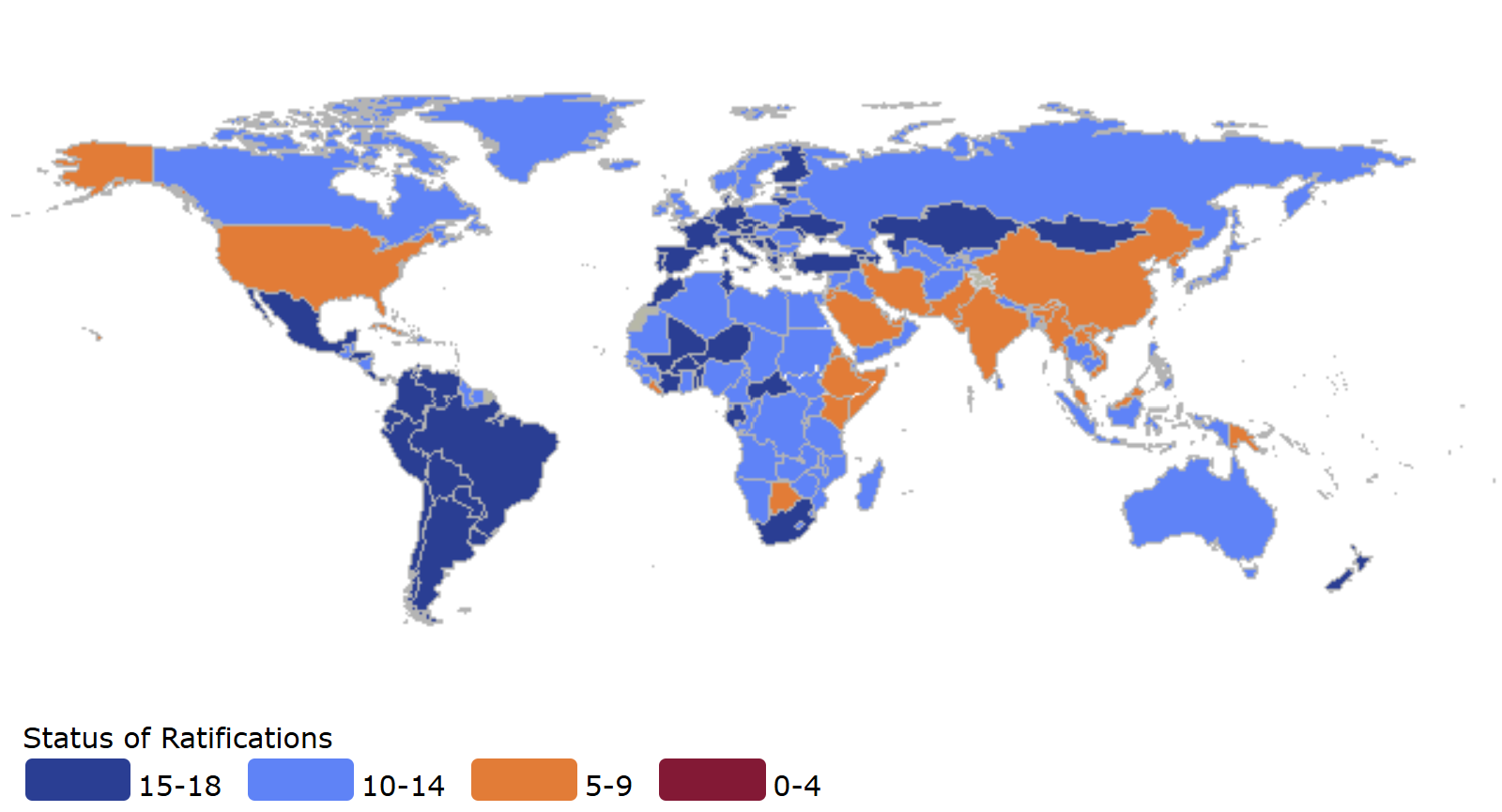
As a U.S. citizen, I grew up hearing how lucky we were to live in a country that offered us the freedom of speech and opinion, as if we were one of a kind. As if we owed our rights to America and America alone. Meanwhile, 173 countries are states of the ICCPR (which means they’ve ratified it), while a handful more have signed it. There’s actually this very cool map that shows which countries are at which standing with the treaty. Dark blue countries are state parties, light blue are signatory parties, and orange parties have taken no action to participate:
Now, if you’re not like me and you don’t have an ingrained interest in these types of details, you may be wondering, again, why this should matter to you specifically. It matters because what you think of when you hear “freedom of expression” or “freedom of speech” is being infringed upon exponentially by the day, and it’s happening worldwide.
What we are allowed to think, believe, say, hear, read, and access is being limited. Think about the constant government-level battles and sales made over who gets to own certain social media or news media platforms, who gets to decide what comments and posts are and aren’t allowed online, and growing surveillance over what your digital presence says about your beliefs when you try to cross a border.
The International Council recognizes this on paper. While the initial treaty was published in 1966, a comment was adopted into the treaty by the UN in 2011. “General Comment No.34 on Article 19: Freedoms of opinion and expression” establishes just how important freedom of expression is to a free and just society overall, stating:
“Freedom of opinion and freedom of expression are indispensable conditions for the full development of the person… [and] constitute the foundation stone for every free and democratic society… Freedom of expression is a necessary condition for the realization of the principles of transparency and accountability that are, in turn, essential for the promotion and protection of human rights.”
What a banger. Straight to the point, and somehow still ignored by those in power of state governing rights and legal consequences to their citizens for exercising such rights. Don’t believe me? The UN Special Rapporteur on freedom of expression and opinion publishes an annual thematic report with warnings and violations committed across the globe. In 2024, they cited the lack of freedom of expression surrounding violence in Gaza, and in 2025 they cited the lack of freedom of digital expression during elections. Just to name a couple.
But wait, there’s one more extremely important topic discussed in General Comment No.34, and that’s the right of access to information. When an individual has the freedom to have and express an opinion, they should have the right to be informed about what they think, what they say, and what they’re truly fighting/campaigning/voting for.
Inaccessibility is a human rights violation, and I would argue that the systemic decline in literacy and education in media literacy is a rights violation as well.
And by my own interpretation of their work, it seems UNESCO agrees with me.
They believe that access to information is absolutely fundamental to building a free society. Access to information doesn’t just mean that the books are there to buy if you want them, or the info is there if you know where to look and how to decipher it. To build a truly free and knowledgeable society, we need to make sure everyone has access to those sources and, in addition, the ability to understand them. This is why literacy is so important.
When we have a society that is getting progressively dumber, statistically, it begs the question of why. The reading level in the United States is extremely low. Over half of the US population reads below a sixth-grade reading level. Why is that?
Why aren’t children and young adults being taught properly? They must attend school. Why aren’t our schools teaching them to read and think for themselves? Who has set the curriculum? In a country where “no child should be left behind”, I regret to inform you that most of our children were left behind.
Ultimately, if over half of our citizens are unable to understand information written above a sixth-grade reading level, they do not have access to that information. That’s an undeniable human rights issue within our own fifty states.
Deliberate complexity is a recognized form of censorship that applies to all ICCPR signatory states. Which, as we can see in the map above, is most countries.
Since declining literacy rates, proctored algorithms, and biased news reporters make it virtually impossible to know for sure what is actually going on worldwide, we have to ask ourselves: who benefits from this inaccessibility?
I can’t answer that for you. I can only guess. While on paper, the United Nations General Assembly is fighting against this human rights violation, it’s actually gotten worse. In September of 2015, all 193 UN Member States adopted the “Transforming the World: 2030 Agenda for Sustainable Development”.
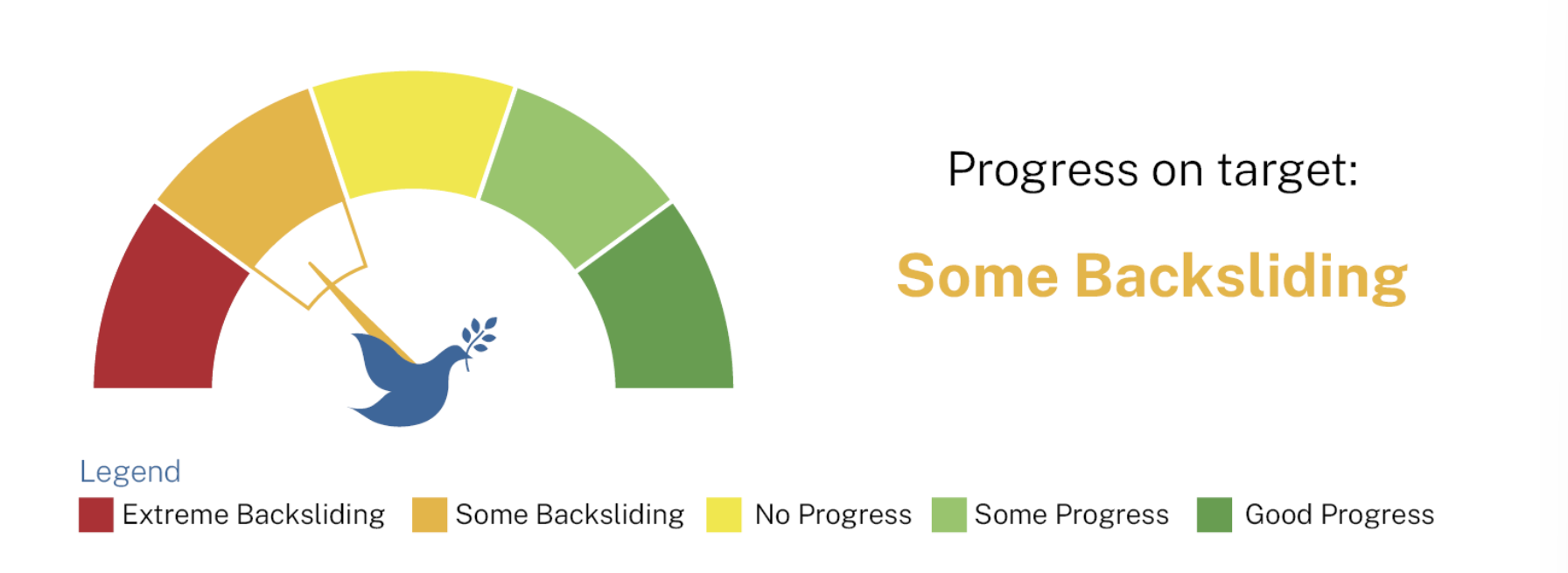
Sustainable Development Goal (SDG) Target 16.10 aims to, “ensure public access to information and protect fundamental freedoms, in accordance with national legislation and international agreements". Here’s their progress report, a mere three years and three months from 2030:
Article 19 and SDG 16.10 are only two, albeit well-known, frameworks fighting against inaccess to information. It’s important to know that there are several others that, when combined, show a sense of solidarity around the globe. There’s no need to lose hope yet. International consensus on your right to know and have educated opinions and to voice those opinions is alive and well.
The Aarhus Convention was adopted by the UN in 1998 under the Economic Commission for Europe and is one of the most enforceable international tools that exists in the name of information access. It was formally called the Convention on Access to Information, Public Participation in Decision-Making, and Access to Justice in Environmental Matters. Very on the nose. 47 parties have agreed to this convention that creates a specific, actionable procedure for governments to follow. For example, Governments have to provide truthful environmental information; it has to be in a format that is accessible to all, and it has to be provided within a certain timeframe.
And most importantly, there are repercussions when this isn’t followed (kind of). The committee, the ACCC, they pretty much publicly bully them into making the necessary changes by pressuring them into compliance through formal findings. If this doesn’t work, a regional system can demand the necessary fines.
Now that’s for Europe. In the Americas, we have Claude Reyes v. Chile (2006). In this particular case, the Inter-American Court of Human Rights officially recognized access to information as a fundamental right. Similarly, the African Commission on Human and People’s Rights adopted the Model Law on Access to Information in Africa in 2013. So, across continents and countries, regional courts are agreeing with the ICCPR and UNESCO.
Like many international frameworks, the intention is there, but there is quite the gap between what is expected and what can really be done when the rules get broken. Some of these convention signatories regularly break their own rules. I mean, that SDG 16.10 progress report speaks for itself. We are nowhere near where we should be in 2026.
The frameworks aren’t entirely the problem. I actually think they’re pretty good. The problem is the ones who enforce are the ones deciding what they want to give their publics access to anyway. It’s like asking someone to grade their own exam, or tell the truth about where they went last night when their mom asks. No good.
This issue isn’t hypothetical for me. On a much smaller scale, I’ve watched this happen throughout my career. I’ve worked in environmental and sustainability marketing as well as health care marketing. And let me tell ya, experts in the field don’t care about telling their possible client/customer base the truth if it means they don’t get to meet their bottom lines.
It’s actually quite sad, and I consider my writing to be my own form of human rights advocacy. I started my medicinal plants database, not necessarily because I’m gung-ho for unconventional medicine, but because I saw a rising trend in herbal medicine without important key information being included, such as drug interactions or pregnancy dangers with certain teas and edible plants. I write about legal, political, and cultural frameworks because I care about knowing as much of the truth as possible, and I want you to know those things too.
There’s a Dutch communication scholar named Cees Hamelink who has been arguing for communication as a human right itself since the 1990s. His thing is kind of like, access to information and communication that information isn’t the cherry on top of human rights; it’s the foundation.
He’s not alone. There are lots of writers who have exemplified this in their writing for decades. James Baldwin, bell hooks, Noam Chomsky, and Ta-Nehisi Coates. They write about serious structural issues within society, like race, power, and language, in a way that the common man can deeply understand and apply to their own thinking. They may not have been thinking of human rights when they sat down to write, but that really is what they’ve done. They’ve committed political acts in their work.
Information has always been and will always be power. The act of taking the information from the few who hold it and dispersing it among the people as a whole is an act of advocacy.
There’s a whole discipline dedicated to this: rhetoric. At its most fundamental level, rhetoric is the study of how language creates understanding and moves people to think and/or act. This means that rhetorical training is the key solution to closing this gap I’ve been discussing throughout this essay.
Here’s what I mean by that. The problem isn’t that information doesn’t exist. It totally does. There’s academic literature on the issue of deliberate complexity and censorship, on propaganda and the declining literacy rates. The problem is that for some reason or another, it isn’t reaching the people it needs to reach. Either it isn’t available in front of them, or they are unable to decode what they’re reading and seeing.
Not everyone can formally study rhetoric, I suppose, but everyone can find writers who have. Those who do study rhetoric can make a real difference in how everyone can access and understand information. The individual must fill the gap in responsibility left by international courts who fail to govern their own parties’ leaders.
The right to understand shouldn’t be an elite luxury. It shouldn’t be for the few, or for those with the funds to afford further education. The right to understand is a human right, fundamentally, that holds a long tradition of people who chose to devote their lives and work to help achieve it for everyone. But it hasn’t been achieved yet. We’ve got work to do.