Abigail Shaw
Writer, communicator, etc.

Political instability in the Western world can be viewed through the lenses of quantum physics and linguistics, where human unpredictability, observed behavior, and polarizing language interact to push our political systems from a stable equilibrium to increasing polarization. Good Lord that sounded pretentious. Let’s try again.
Have you ever tried to push a magnet together, but you had the wrong sides facing each other, so it kept shooting off to one side or the other? Have you ever seen one of those little desk decorations on a teacher’s desk where five balls are hanging from strings? And then when you pull one ball back, it keeps going until someone stops it, so your coach looks at you with exasperation because he was apparently saying something important? No? Just me then. Either way, IF that has happened to you, then you have first-hand experience with what we’re about to discuss.
Anyone who has watched the Marvel movies knows what quantum physics is at a baseline. You know, when Ant-Man becomes the size of an atom particle, and he travels to the quantum realm where there are just infinite particles and universes, and Elizabeth Olson can manipulate reality, and… okay maybe not. Really though, quantum physics is basically the study of matter and energy and how their tiniest particles interact.
So now you know about quantum physics, but what about quantum politics? I’m neither a politician nor an experienced physicist, so let’s ask someone who’s BOTH. Armen Sarkissian, former Armenian president and physicist who studied at Cambridge with Stephen Hawking, coined this term that we’ll be discussing, “Quantum Politics”, and since then this term has been used to describe United States politics by others, but also, now, by me.
Let’s break this down just a wee bit more. Newtonian physics (we’re talking apple + gravity = fall) is predictable, and you probably learned about it in grade school. We know what is going to happen when we let go of an apple high above the ground. It’s expected. Quantum physics, on the flip side, is unpredictable and uncertain. It says that the simple act of observing something changes its outcome.
So you reading these words right now is affecting the quantum world we’re in. You observed the words that I spent energy typing. And now your brain is thinking. Who knows what you’ll think or do next.
Now, when we connect this to politics, from that quantum perspective, we see that outcomes are uncertain and observer-dependent. Most, if not all U.S. citizens observe or consume media, and this media consumption alters beliefs and behaviors. Media is created by humans. Politics involves humans. Candidates and voters are human beings, and human beings can be behaviorally volatile. So A + B = C. Because of this unpredictability that comes with media and humanity, quantum physics becomes the perfect metaphor for our current political situation (and by that, I mean a political situation on the brink of constant “breaking news” updates and voter whiplash).
Like, we’re all exhausted.
Let’s dig into the quantum principle that “observation affects reality” a little deeper. Viewing, hearing, or learning something is going to impact our knowledge base and affect our opinions. You know what I mean. We’ve all had those days where there have been too many depressing or stressful news stories one after the other, and we lose all motivation to do what we originally had planned for the night. Observing that news changed our behavior, because now we’re curled up in bed with raw cookie dough and rewatching Gilmore Girls instead of doing that thing we should be doing.
Furthermore, with current social media algorithms, this becomes more complicated. Algorithms amplify content based on engagement. Let’s say someone is engaging with soft-core, red pill content. Then they unknowingly go down what we know is the “Red Pill” far-right pipeline (an essay for another time, but a prime example… Andr*w T*te lovers, I’m looking at you). On the other side of things, if someone regularly likes and comments on far-left journalists and news sources, they will be shown more of those sources alone. Eventually, their algorithm doesn’t even place other opinions on their screen, so how can they know they are there?
This leads to three things: False Consensus Effect, i.e. when you think way more people agree with your point of view than is true in reality. Confirmation bias, i.e. you really only seek out and interact with people who already think what you do. Echo chambers, i.e. these creepy, intangible things that have materialized with the rise of the internet and social media. It’s the result of the algorithm working too well. Everything you say or think is echoed back at you... you can’t escape… the tunnel!
Media intake is funneling viewers into reinforcement loops where people only see content that reinforces what they already believe. You can no longer make an educated opinion on something, because you’re no longer being educated by the news that’s being chosen for you. Not in a holistic, bigger-picture way at least.
This exponential buildup of extremist content leads to heightened emotions, such as anger and fear, which are more likely to induce behavioral volatility in people. This matters because we can’t have people acting out of anger and fear that’s been echoed back to them (a.k.a the people who vote in democratic elections). These unpredictable and polarized media patterns shift the political landscape from (back to physics again) a nice, balanced bell-shaped curve, where we have a moderate majority, to an M-shaped distribution with political extremes. The intake of media and observation of social and political data is no longer passive. It actively reshapes the political system, which means algorithms are systematically shaping the political landscape.
Which makes me wonder, who is choosing MY algorithm? And who is manipulating my understanding of the political landscape in which I live?!
You should be asking this too!
Because this polarization isn’t happening by accident, which means an active solution is necessary.
I’m really only telling you all this because the end goal is a better future, and to predict and manage future outcomes, one has to understand the past and current data.
Let’s use the years of 1945-ish to 1970-ish of the U.S. presidency. In case you didn’t also have to memorize the Presidents Song in preschool music class, these were the presidents during this time period: Harry S. Truman, Dwight D. Eisenhower, John F. Kennedy, Lyndon B. Johnson, and Richard Nixon. While all these dudes (ugh, don’t remind me. I’m praying for a female president before I die) were members of different political parties, they were fairly moderate in the sense that they leaned towards the middle from their respective left or right parties. One could argue, and I will, that these candidates genuinely represented what the majority of citizens and voters wanted to lead the “Free World” (ironic wording considering the conversation).
For about 25 years the U.S. political landscape was in stable equilibrium because of this tilt towards the middle. Think of a ball in a valley. There may be small pushes to the right or left, but natural momentum always brings it to the center of the valley. This model is explained much more eloquently in “The Art of Physics: Eight elegant ideas to make sense of almost everything” by Zahaan Bharmal (Chapter 5), probably because he’s an actual physicist, but I’m doing my best here. Overall, there was low polarization and broad consensus in politics during this time of bell graphs and stable equilibrium. The ball (the policies and work of the president) gravitated towards the middle (the consensus held by his or her constituents).
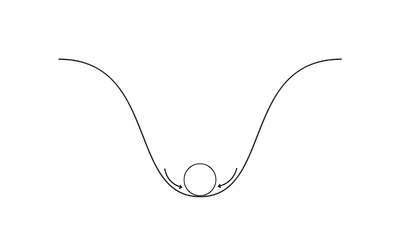
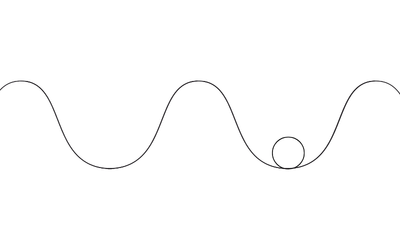
Alas, it could not last (not that it was perfect, but presidents and voters seemed to be on the same page). I think it’s fair to say that our two-party system is not often openly in policy agreement. Our government has been in a state of mad oscillation since the 70s. We went from a valley to a mountain with an unreachable peak and two totally divided valleys on either side. There's no way that ball is making it back to center on its own. There is no consensus, just two sides of one very conflicting spectrum.
To visualize this, think of a pendulum. Since the 1970s, we’ve had Richard Nixon, Gerald Ford, Jimmy Carter, Ronald Reagan, George H.W. Bush, Bill Clinton, George W. Bush, Barack Obama, Donald Trump, and Joe Biden (oh, and Donald Trump again). The ball on one end of the pendulum hit once, then all that force built up and swung out a little harder on the other side. Ope, and back again a little harder. Now the pendulum swings back and forth with an exponentially growing force, leading to further polarization in each direction.
This is why my coach was so annoyed I reached out and messed with his pendulum desk decoration mid-conversation, because now it had to be dealt with. In my defense, why would he put it so close to where a 16-year-old was sitting?
Just as my coach’s pendulum kept its momentum, characteristics of this back and forth are sustaining ideological contrasts between both sides. A symptom of this can be seen during presidential campaigns, where the campaign runs on specific, far-leaning partisan issues to get the vote rather than focusing on representing the majority of constituents well.
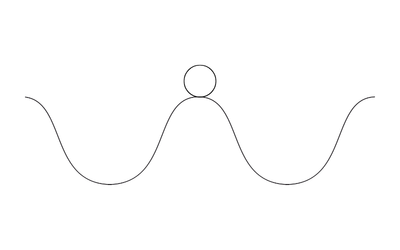
Right now, in 2026 as I sit here writing this, the U.S. is in a state of unstable equilibrium. Before, we had a ball at the bottom of the valley. Little shoves this way and that caused some movement, but it always returned to center. Now, the ball is at the top of a hill, and any little nudge or poke has a higher risk of complete gravitational pull to the bottom of either side to total unstable mayhem. Any shift leads to divergence (instability) rather than a return to center (stability). There’s nothing to restore the force to that center and, as a result, we are rapidly diverging into extremes. We are at extremes. We’ve been at extremes. I’d argue that there isn’t one person to blame, though pointing the finger may be easier to do. This instability is a symptom of a greater system, and it will continue to be unstable with future presidential and political leaders until an active force returns it to stable equilibrium.
But how can this be solved while current forces are causing that polarization? Anyone on social media or tuned into news outlets knows that things are always heating up. It’s similar to how heat affects a magnet. Remember that magnet we tried to stick together on the wrong sides? Well, forget about that, because now we’re heating it instead.
Temperature has the power to affect the magnetism of materials by destabilizing atomic alignment. Heat + magnet atoms = no stick. If we think of social media, information overload, and language as “temperature” increases, we can imagine how they are impacting polarization by “heating up” the political landscape. As a collective, the public and voting body is no longer aligned. We (the atoms) are all over the place. We’re heated up. There’s no stick!
We have access to extreme viewpoints on both sides and our algorithms are shepherding us into very distinct pipelines. When we finally look around, everyone else within our pipeline has been shepherded there too. We don’t even know that the other pipelines are just as full of people, so we all think we must be right. How are we pulled into these pipelines? This is where language comes into play. I mean physics can’t do everything. Give it a break.
Shared language shapes our reality, or at least our perception of reality. Like how my little siblings say someone has “rizz”, which meant nothing to me until I realized it was the new age term for, “that guy has game!” Before they explained how stupid and old I was, I thought rizz was a candy in a blue wrapper and nothing else (turns out I was thinking of Razzles). How silly of me.
But that understanding of language shaped my reality. Now think of more important uses of language than my sister calling a lil’ player a candy. News outlets, political campaigns, we have access to it all. Language makes up media and communication, like completely. Ideological language, generic language, and target language all affect how we perceive truth. For example, broad claims such as “Democrats want XYZ (negative thing)” or “Republicans are to blame for XYZ” can be heard everywhere. Lumping entire groups into extreme viewpoints (example: pro-life or pro-choice) eliminates space for common ground (that stable equilibrium we were talking about) and creates an “us vs. them” situation. It eliminates the possibility of internal variation within both groups and exaggerates differences between people who identify with either.
This is in-group vs. out-group framing. Amanda Montell talks about this in her book “Cultish: The Language of Fanaticism” (which is such a fun introduction to linguistics by the way. 5/5 stars from me). This us vs. them framing is a psycho-social concept in which individuals define themselves by either belonging or not belonging to a group.
If you’re in the group, you’re the BEST, and you’re totally right always. You are preferred over anyone who isn’t. Then you view anyone outside of your group negatively because they’re, like, SO wrong (i.e. harmful stereotypes and systemized hate… eek). Not only are you a part of this system already, but you’re now getting it spit back at you and repeatedly confirmed by your social media algorithm.
It’s a never-ending loop that you can’t escape… the ever-looming algorithm. And you don’t want to stop because you WANT to be informed. Except now, the messaging is more extreme. And now the voters are more extreme, so the candidates are more extreme. And the pendulum swings on.
But this entire argument using physics with a touch of linguistics to explain our current polarized political sphere doesn’t take into account everything else that influences politics, like institutions, economics, finances, culture, the job market, and technology. Our world is ever-developing, so politics is too. This conversation only takes into account a few pieces of the puzzle (unpredictability, polarization, and language), but they are important pieces.
These models I’ve used to make sense of the political polarization are analogies, not laws carved into stone. Certainly, we can agree that stability is better than instability, and U.S. politics could use some stability if I do say so myself.
Possible paths towards stabilization? We elect Barbie as president. I mean, she has the most experience.
Since I’m not sure you’ll go for that, how about electoral reforms, institutional constraints, fact-checking in campaigns, media literacy… and, in general, literacy. For the love of God, teach the children! Let them become our next educated and knowledgeable scientists, linguists, and politicians.
I haven’t been around since the 1940s, but I can infer that the U.S. political system has transitioned over time by observing history. The U.S. went from a stable equilibrium to an unstable, self-reinforcing polarization. From a bell curve to an M-shaped graph. From a centered valley to a swinging pendulum. What’s important to note is that this stability is not random. It’s systemically produced by institutions, political campaigns, and social media algorithms. Without intervention, our political system will continue to diverge from a central, stable ground. Reintroducing a “stabilizing force” is necessary to return to stability. I don’t know, maybe YOU could be that stabilizing force. Throw out your hand and disrupt that pendulum’s swing. wink wink
Essay inspired by Chapter 5 “The Physics of Breaking Up” from “The Art of Physics: Eight elegant ideas to make sense of almost everything” by Zahaan Bharmal.
I write a lil something like this usually once or twice a month. Drop your email, and I'll send it straight to you. No newsletter format, no extra spam emails. Just the essay. (Mom this is for you.)