During a class trip abroad in 2020, I sat around a large table of my peers while we all went around answering the question, “What time in history would you go back to and why?” when one of the guys on the trip answered, “When we bombed Hiroshima, so I could watch them all burn.”
First of all, that question only sounds fun if you've never had to think about what history would have done to you. Ah yes, take us back in time when minorities had fewer rights. I’m sure that’s some privileged creep’s dream, but I like to think the majority of people don’t think that way. Second of all, and most importantly, what possessed that man to say something that evil? How does one even come to think that?
I mean, what a monster. How can someone living in America, the land of the free, who took history classes throughout their entire childhood, who learned all about the atrocities our armies committed, be so clueless?
Oh wait. Do Americans learn true history in history class? Or do we live in a culture that has taught us that certain deaths are war story curiosities rather than human tragedies?
I’m arguing the latter.
To be clear, I am not making an excuse for unacceptable behavior in any way, but I do think looking deeper into the culture that thinks said behavior is acceptable is the first step in changing for the better.
Not only are social media and daily news announcements making us all increasingly desensitized to the mention and view of mass violence, but the average American has never had to deal with it on the scale that citizens of other countries do. Most of our viewing of violence is through a screen.
Other than 9/11 and Pearl Harbor, America hasn’t had to fight wars on our own land. We’re always taking it elsewhere. The everyday American lacks first-hand experience of war and tragedy.
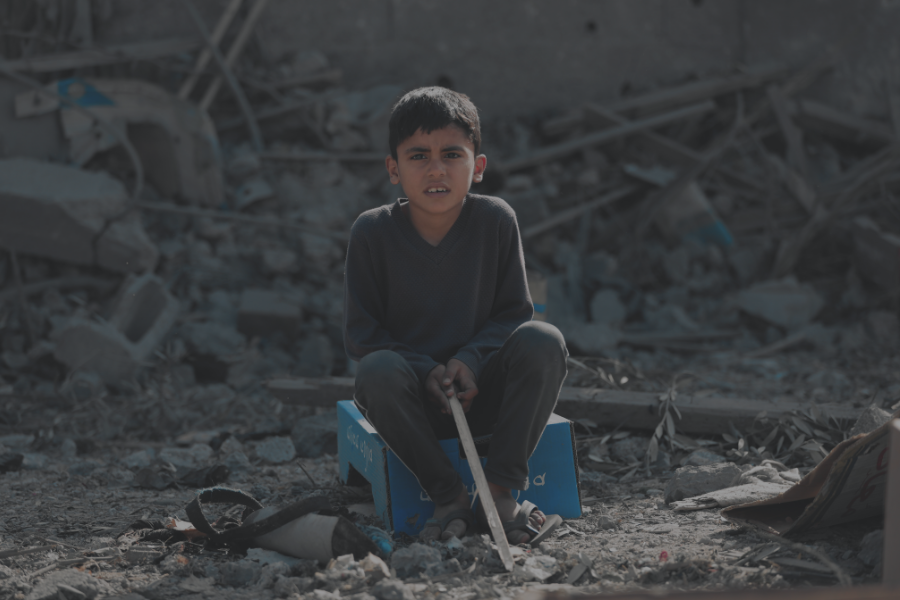
We hear about it all the time on the news. Kids in South Sudan are starving. Palestinian civilians are getting bombed in their sleep. Ukraine is getting its ass beat by Russia. Iranian children are getting bombed while they’re in class. Now people are getting bombed on their way into work in South Lebanon.
“But those Sudanese people are at war and killing each other themselves.”
“But Hamas is hiding in Palestine!”
“But that Zelenskyy is no saint either. He’s a bad guy.”
“But they didn’t mean to hit the school. They were aiming for a nearby Navy base.”
“But Hamas is now in South Lebanon. They need to be stopped.”
I hear and see a lot of excuses in both in-person and online conversations, focused on the “why” the violence can be excused rather than the fact that innocent people (and children!! CHILDREN!!) are not only being murdered, but worse. They’re losing everything: livelihoods, limbs, loved ones.
Americans' geographical distance is real, and so is our moral distance. The isolation and individualism we have created as the backbone of American identity are deeply ingrained in every political decision we make. The fact that bombs are not falling on our schools, neighborhoods, and places of worship has become an excuse for not reckoning with the fact that they are falling on someone else’s. Geography contains lines and borders, but basic humanity and ethical treatment do not.
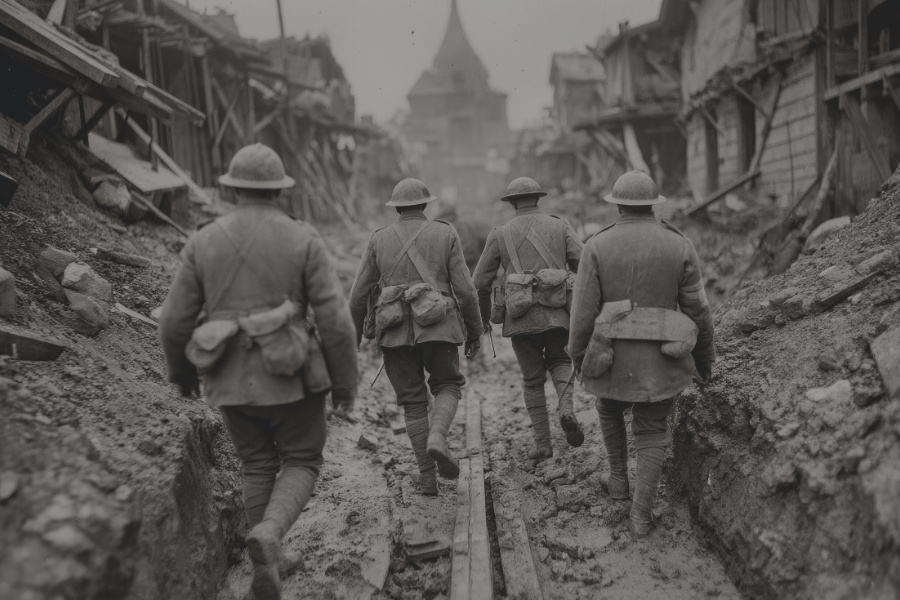
Our entry into World War II is instructive. When we read about Pearl Harbor in our textbooks in high school, we see the rage and anger that Americans felt at being attacked on our own soil, losing our own people right in front of us. Suddenly, after refusing to ally with the Allies despite their pleas, we understood the gravity of war and loss after one single morning in Hawaii.
Before Pearl Harbor, millions of people were dying, Europe was burning, and American political engagement was seriously limited. Well, unless you count the food, weapons, and equipment to the Allies if they paid in green (money and land rights). We draw the line at charity unless it’s one of our buddies. It took a direct attack on our soil to make the war feel real.
That line that we’ve drawn in the sand as a country, the threshold that direct and flashy American suffering is the condition for American moral engagement, still lives strong in us today.
The country that felt the bombing of Pearl Harbor was justification to enter a war against genocide, and power-hungry leaders turned around and dropped atomic bombs on two civilian populations, killing somewhere between 130,000 and 246,000 people, the majority being civilians.
Sometimes numbers are hard to visualize and really understand, so to put that death toll in perspective, I’ve created a list of just some of the U.S. cities that either have military bases within or nearby. So the bombing we committed in Japan would have been the equivalent of them bombing and killing every single person in one of the following cities:
Do you live in one of these cities? Do you know someone who does? Do the nurses, teachers, baristas, cashiers, mechanics, and students in these cities deserve to die because there’s a military base/field of some sort nearby? No. Of course not.
At least you’d think we’d all say, of course not, but in June of 2025, the Pew Research Center conducted a poll on whether or not Americans felt Hiroshima and Nagasaki were justified. 35% said it was justified, 31% said it wasn’t, and the rest said they weren’t sure one way or the other.
If it had been Alington, Virginia, or Scottsdale, Arizona, rather than two cities overseas, I would venture to guess our answer would be vastly different.
The difference in how American culture has processed these bombs versus how Japanese survivors and their descendants have processed these bombs is one of the starkest illustrations of how geographic and political position determine whose suffering counts as tragedy and whose counts as consequence. If you’re not American and it’s not happening here, does it really matter to us?
And if you're tired of hearing about it? Good. Sit with that. The people living it don't get to be tired of the conversation.
Yes, it was years ago. It’s over and done. Nothing to be done about it now, so why bring up the past?
Because it isn’t the past. We are watching this exact phenomenon repeat itself today.
Our military just bombed Iranian civilians, children in a school. Gaza has been completely obliterated. The Palestinian people’s genocide and erasure have been documented in real time and shown to each of us every single day. Most of us here in America have seen the literal footage of the violence enacted against them. The names of the dead are known. Their faces are known. Many of us watched Palestinian citizens report from the ground about their situation on TikTok and other platforms until one day they disappeared from our feeds. Who remembers them? And who will remember South Lebanon when the same happens to them?
America’s political response has not been focused on this scale of human loss and catastrophe. No, our response has centered around strategic interest, alliance maintenance, and domestic political calculation.
The gap between what is happening in front of us and what is being discussed in the American political and media landscape is the institutionalized parallel to the desensitization of that kid in my travel group years ago.
The language used in media blasts and press releases maintains the psychological distance that makes this disconnect possible. Our lead communicators are using the language of conflict rather than the language of massacre. Civilian deaths are framed as unfortunate but necessary collateral rather than murder. We replace the names of bombed children with numbers and statistics.
Reporting “206,000 deaths” isn’t nearly as reflective of the situation as saying, “every single family, man, woman, and child in the Springfield metropolitan area is dead” would be.
The way we communicate the reality of what’s going on shapes our understanding of what is happening to real people. Real human beings.
A child in Gaza and a child in Ohio are the same. Those two children want the same things. They are afraid of the same things. They both want their mom to tuck them in at night and their dad to check for monsters under the bed. The only differentiator is the geographical location they happened to be born in and the situation they happened to be born to. We have allowed the happenstance of location to determine the value of their lives. The fact that bombs are not falling on one child's neighborhood does not make that child's life worth more. It just makes them luckier.
Our active conflation of who is worthy of safety is the moral error that sits in the center of American disengagement from global suffering. That kid in my class is not alone, and he himself isn’t the problem. He represents a stance held by American institutions, governments, and media systems that have decided that some deaths are more important than others.
Our understanding of distance and the value of life is costing everything for innocent human beings on the other side of an imaginary line.
If you want to take a look at that poll, here it is:

.png)