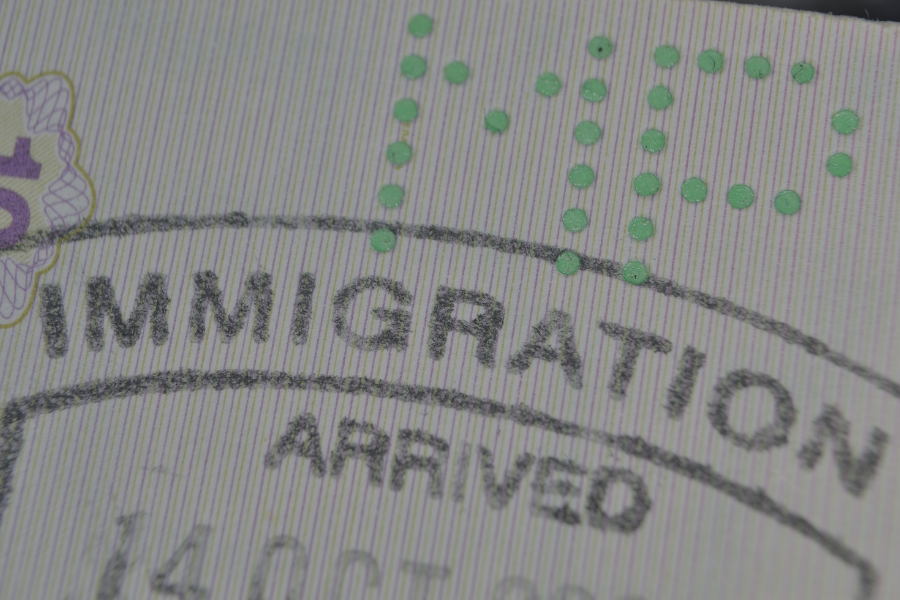
Lots of families have an inherited "this is what happened at Ellis Island" story. I mean, I don't, but I know people who do. We've all heard the popular story that immigration officials at Ellis Island routinely and carelessly misspelled last names on arrival documents, maybe even on purpose sometiems, but historians and genealogists from the National Archives have debunked this version of events.
According to them, inspectors didn't invent new spellings; they checked names against ship manifests. The truth of why and how culturally significant names were changed during migration to the United States is much more rhetorically interesting than a group of lazy ship inspectors being thoughtless.
In many instances, names changed through self-anglicization due to enormous amounts of social pressure. Immigrants felt they had to simplify or translate their own names in order to assimilate faster and avoid discrimination. This was a survival tactic. Immigrants needed to get hired and their children needed to get accepted into school. The result? Making their names palatable for the English-American.
Sometimes it didn't happen quite so suddenly. Names also changed gradually over generations through simple mispronunciation that wasn't corrected. Like a decades long game of telephone where the end result is a totally new version of the original message. Clerical errors in later paperwork, think census records, marriage certificates, school enrollment, or military registration, turned the spelling mistake into the new surname. And perhaps, even later on, the change or Anglicization of a name was a deliberate choice by descendants of immigrants who wanted to distance themselves from an identity that made them a target of whatever social and political landscape they were living through in America.
The myth of careless officials lets history off the hook. In reality, people were changing their names because the alternative of being "other" in the United States was worse. It was more dangerous and more painful.
Slavic and Eastern European names were especially vulnerable to loss. Slavic languages, and sometimes a separate alphabet, contained consonant clusters and diacritical marks that simply do not exist in English. Not to mention, many Eastern European migrants had already passed through German or Russian administrative systems before reaching the American administrative system. A slightly different game of telephone with the same end result.
Not all migrants came from a culture that assigned them First-Middle-Last name structure. For example, in Russia and Ukraine patronymics serve as official middle names. A son's "middle name" would simply be the name of his father plus son. Western European immigrants had last names that pertained more to the geographical location of their family. German and Dutch surnames beginning with "van" (from) or "von" (of) indicated the region specific village a family line originated from.
Not to mention, women who came over with their husbands lost a historical connection to their maiden names all together. They became a part of their husband's lineage in a new land. Their name possibly lost for good. I've found this pattern repeatedly throughout my own ancestral tracing. It is much more challenging to find a great great great grandmother's maiden name and trace her line back, but it is very easy to trace my paternal lines back to as early as the 1200s, especially when you incorporate migration into the mix.
A piece of identity is lost when a name changes, regardless of the reason. A name carries so much. It carries a language's unique pronunciation, a name's geographical origin, and a family history. Sometimes an entire linguistic logic is lost. VanXyz no longer means "of this", it's seen as just a Dutch last name. We've lost information conveyed to us by cultural last names, like occupation, ancestral identities, regional identity, and direct lineage.
That all disappears when a name anglicizes. Even if most legal letters stay close to the original, that deeper connection is lost. A rename is a compression of individual history.
My 3rd great grandmother, Anna Erickson (married name) left Gdańsk in the late 1800s, arrived in the United States through Duluth and the Great Lakes ports, and made her way to Carlton County, Minnesota, where she lived out the rest of her life. Sadly, I have not found her original Kashubian surname, since all her documentation since coming to the country holds only her Swedish husband's name. The only trace of her original identity that survives in family memory is her first name, the place she came from, and the fact that she came at all.
Gdańsk went through an ordeal of historical events leading up to Anna's emigration from Poland. The Spring of Nations revolutions swept across Europe in 1848. The revolutionary dominoes fell across 50 countries, but the Greater Poland Uprising of 1848 was crushed and ultimately a failure. Prussian authorities decided that the attempt of an uprising required a crackdown on political repression across the partition.
This political repression included Pomerania, the place in which Gdańsk sits and where the Kashubian people had lived for centuries, my great great grandmother's family included. The rhetoric coming from the Prussian administration in this period was about control and assimilation, and it was circulating. At the same time, the possibility of escape quietly circulated within Kashubian communities, through churches, through families, and through the America letters beginning to arrive from the earliest emigrants. It was while these secret messages of hope and possibility were flowing through her community that Anna decided that she would be one of those emigrants.
Her move was quite possibly a result of those letters from America, since they were a common and now well-known recruitment tool inviting other Polish people to escape to America so they could be who they are freely. These correspondence sent home by early emigrants described land, opportunity, and freedom from the pressures back home and functioned as the most powerful rhetorical tool that kickstarted the great 19th century immigration from Poland. They worked because they were first hand accounts.
Letters from loved ones are more persuasive than any government policy because they came from trusted voices, neighbors, cousins, people the community already believed. Kashubians like Anna came from this exact region, and this exact era is one of the most documented early waves of Polish region emigration to America.
Many Kashubian immigrants arrived directly in the midwest with major settlements forming in Portage County, Wisconsin and Winona, Minnesota starting in the mid 1850s. My ancestor left in the second half of the nineteenth century, so she was likely responding to exactly this kind of rhetoric, a promise carried across the ocean in someone else's handwriting, when she moved to Minnesota.
While death records show that Anna died in Carlton County, Minnesota, many Kashubians moved to Winona, Minnesota. It became one of the most significant Kashubian settlements in America as it was organized institutionally around St. Stanislaus Kostka Church. As a result of this new community, a cultural identity that had been suppressed in Gdańsk Pomerania was rebuilt in Minnesota.
The Kashubians were able to reconstruct through parish records, maintained language and brought customs. My great great grandma was part of a community that chose to reconstruct itself rather than dissolve into a generic immigrant assimilation like so many were forced to do in the states.
Despite the community built in Winona, Anna left for Carlton County with her Swedish husband and his Swedish name. Scandinavian immigration to Minnesota was happening on essentially the same timeline and into many of the same rural counties as the Kashubian settlement, so it's no surprise they met. An intermarriage between a Kashubian woman and a Swedish man in that era reflects how these immigrant communities were geographically overlapping and occasionally merging even while maintaining distinct cultural identities. Because of this, her surname is only Swedish in the records I have been able to find.
Despite word of mouth passed down through my family, her Kashubian history has been partially lost. Not through empire or Prussian policy, but through a quiet domestic erasure that happens to women specifically and constantly throughout history. A history and identity disappearing amidst the loss of a name that connects them to where they came from and replaced by the name of the man they married.
It makes me wonder about the importance of me being the last Shaw in my line as my dad's only child, him being his dad's only son, and my grandpa being the only son as well. While civil documents are kept consistent and organized in current times, there is a loss to that identity if that name goes extinct. The erasure of a maiden name mirrors the same political erasure Anna fled Poland because of.
Something was taken, and what remains is fragmentary, recoverable in pieces but never fully whole again. Even without the name, something survived enough to reach me, generations later. Her story passed down generations, the knowledge of her homeland and her long journey West. Rhetorical and political erasure is powerful, but it is not always total and my great great grandmother is proof of this. Family memory, even fragmentary and nameless, is its own form of rhetorical survival. It's oral history persisting specifically because someone kept telling the story even after the details were meant to disappear.
With a loss of identity in a nation as individualistic and anglicized as the United States, reclaiming a last name can be a reclaiming of cultural identity itself. Everything that comes with a last name is an inheritance that was passed down on purpose. Migration is a beautiful historical path, but there is magic in tracing the line back and finding that original identity for yourself.
I'm pretty good at finding records for my personal history and throughout history in general, but I haven't yet been able to confidently identify Anna beyond her married name. Parish records in Winona might hold it, buried within decades of handwritten Latin, German, and Polish entries. Even though I don't know her maiden name yet, I still know where she stood, where she left, and what she was reaching for when she crossed that ocean so long ago.
Some sources I read to learn about this topic so you don't have to take my word for it:
https://www.nypl.org/blog/2013/07/02/name-changes-ellis-island
https://www.nps.gov/elis/learn/education/finding-arrival-records-online.htm
https://www.statueofliberty.org/arrival-search/
https://www.kaleookalani.org/5463/uncategorized/whats-in-an-anglicized-name/
https://sites.psu.edu/balacivicblog/2023/01/20/anglicization-of-diverse-names/