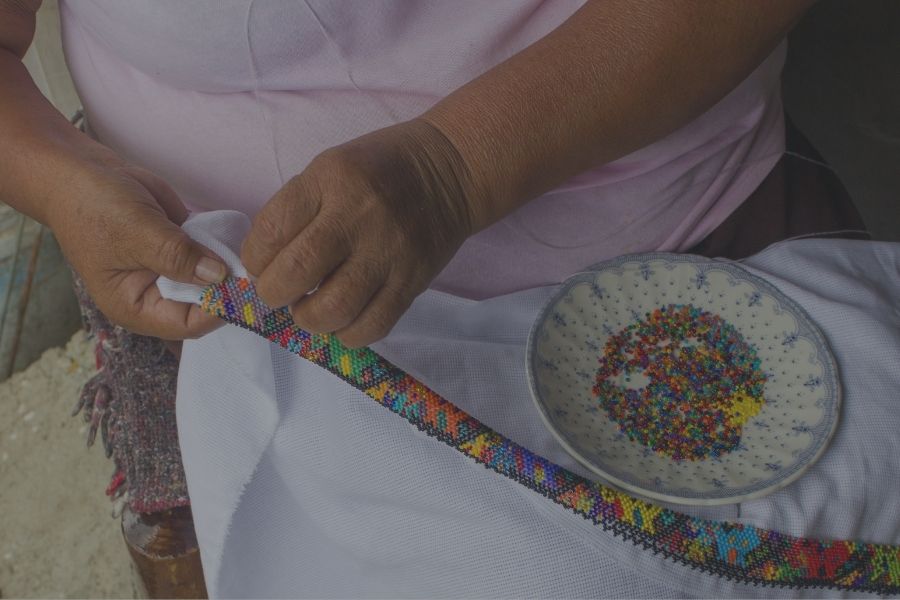
My Nana, my mom’s mom, hand-beaded my mother’s wedding dress to help create the dress her daughter had only dreamed of. My mom married my step-dad in this tiny, adorable church near her hometown, where the priest was ecstatic to perform the sacrament, as there hadn’t been many weddings there before. They were very much in love, and my mom found a beautiful white dress with navy blue accents. It just wasn’t quite her yet. Luckily, she had her mom, my Nana.
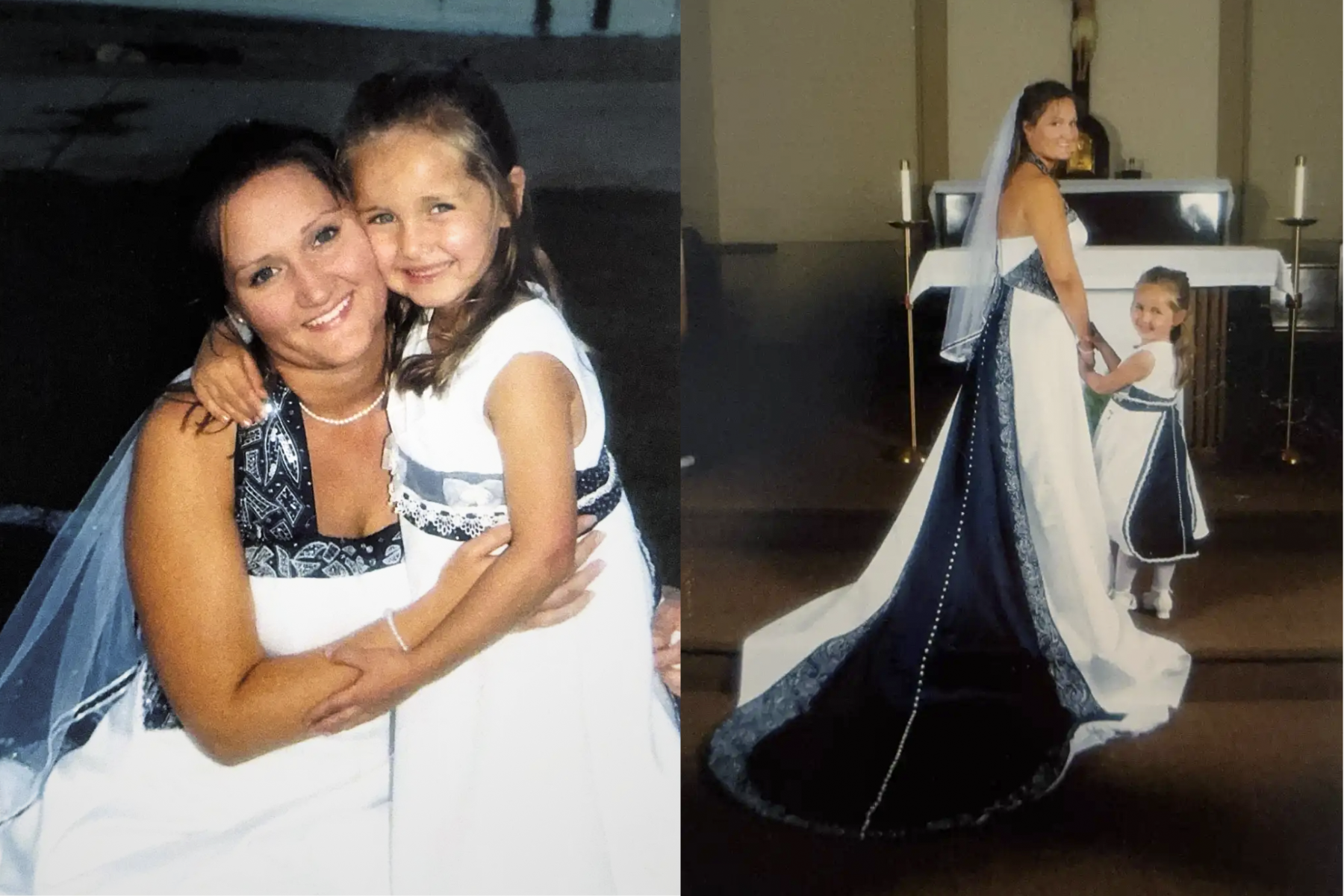
My mother’s mother spent days and days and days bent over fabric, tediously placing one bead at a time, sewing in design after design. Over the span of months, she made something (two somethings–she even added navy blue accents and beading to my flower girl dress to match) that would be worn once but remembered forever. I can only imagine how my mother felt the first time she saw her finished dress, how she felt the first time she put it on. I mean, look at those photographs… she’s literally glowing.
My Nana’s ability to hand-bead her daughter’s wedding dress didn’t stem from a simple hobby or domestic task; it was an artist creating an art form that required skill, time, patience, and love in proportions that modern fashion and today’s quick-fix mindset have decided are economically irrational and not worth the trouble it takes to trace the craft back through generations.
Handbeading has been everywhere during every time period. Archaeological evidence dates beaded textile work back thousands of years across virtually every major culture on earth simultaneously. It has always been more than just a fashion statement.
Beadwork done by Indigenous Americans carried cosmological and clan identity; one method even used porcupine quills to create the designs. West African beaded regalia communicated social and spiritual status to those around them. In South Asia, a practice called zardozi embroidery threaded gold and silver through fabric along with pearls and gems for royals in Mughal courts. Eastern Europeans would wear specific beading colors and styles to communicate regional identity and marital status. Both Ottoman and Byzantine textiles carried heavy embellishment with beads, gems, pearls, and more. Parisian and Lebanese haute couture ateliers still painstakingly bead their gowns. These are only brief and few examples of how far this practice spans.
This practice reappeared throughout history, across continents, among cultures that never communicated. It is something that humans repeatedly discovered independently, because it responds to a deep need to make what we wear communicate something more than cloth can alone. Handbeading is one of the oldest forms of wearable language.
Handbeading a couture gown can take thousands and thousands of hours of skilled labor to finish. In France, they called these artisans “les petites mains”, the little hands, who created Parisian haute couture. Their craft developed over decades of muscle memory and precision required to create the vision of the designers.
In India, they train artisans for years in zardozi workshops before they’re considered good enough to work on large, detailed commissions. The beading on just one traditional garment can represent months of work and encoded information laced into the design. Indigenous artisans wove in information about themselves and their communities in a way that is unreplicable by machine.
Similarly, my mother’s wedding dress’s design could not have been made so exactly, with such beaded shapes and designs, by a machine. It could only be made by hand, stemming from an unbroken human tradition that even today’s technology cannot replace.
Then the industrial revolution arrived and changed everything. It didn’t change what clothes were as an end product; it only changed how they were valued. Quite suddenly, a machine could produce in an hour what had taken skilled artisans over a week. Market logic said the machine was more efficient and cheaper to pay, and therefore the better option. As this continued, the time and skill that hand beading required changed its value. It became impractical. It took too much time, and since time is money, only those with disposable income would spend money on a beaded gown.
The rise of fast fashion in recent decades has solidified handbeading’s place in the world of fashion. I mean, if 200 dresses can be produced for fifty cents each in a factory per day, why would anyone practically choose a garment that took months to make?
The truth is, the dress you can buy with one click for less than $20 online is not a comparable product to a hand-beaded dress. One is a commodity, and one is now an artifact.
It’s why the many beaded gowns in every single collection Lebanese couture designers release every season are so epic, and even more meaningful. The tradition upheld by couture houses like Elie Saab and Georges Hobeika is simply irreplaceable. It’s more than just expensive. These ateliers employ real artisans whose skills were developed over years and years. What they create cannot be created by a machine. The cost behind a gown like this is not simply because of a name or label, but because it holds hours and hours of skilled labor, by artisans who deserve to be compensated fairly. Lebanese designers' work is important for many social and political reasons, but it’s also making an argument about what craftsmanship in a world of capitalist fast fashion is worth.
But hand beading isn’t just a technique, and it isn’t just a luxury that takes skill and time. It’s an entire knowledge and communication system that has been passed down across millennia of generations. It’s a system that encodes cultural identity, regional singularity, and community connection. When we lose these traditions over generations, we lose the story behind them. When my Nana beaded my mother’s wedding dress, she was passing something forward that neither had realized at the time. When true hand beading is replaced by machine embroidery or printed beading effects, the knowledge and identity are lost. If we allow it to be so, it’ll be extremely difficult, if not impossible, to recover. The rise of textile capitalism and fast fashion devalued hand beading economically, while endangering the deeper meaning behind the practice altogether.
I hate to think of handbeading’s place in the contemporary world. What conditions the artisans are working under. Preservation can be seen globally, but it's definitely complicated. Artisans located in India, often Lucknow, are forced to do contract work for Western fashion houses at a pay rate that does not reflect the time and skill involved. Western capitalists are purposefully opening workshops where they have fewer pay regulation requirements. Where have I heard that before?
On the other hand, Indigenous beaders in America are experiencing a revival of traditional beadwork, an act of reclamation and resistance. Many of them, done by younger generations, are showcased in galleries and getting serious attention for all the right reasons. Meanwhile, some small ateliers in Eastern Europe are being preserved by older, dying generations. There are fewer and fewer young people to continue the work. I can only hope they have a revival of their own.
I was so honored to have a flower girl dress that matched my mother’s. I remember being so excited to take photos with our matching dresses. I got to move through that day wearing the same hand-placed designs my Nana sewed into her daughter’s dress (although I ripped it on the dance floor dancing with my cousin Forest… they were not as ecstatic about that. At least we have the photos.)
It’s not easy to feel the weight of what industrial cost us in abstract conversation and writings, but it is possible to feel it when I look at the photo of my mother and me, holding hands and looking back at the camera. I feel it when my Nana tells the story of being bent over the kitchen table, one bead at a time, making something one-of-a-kind, hand-made. A machine could never make a dress with the love and wisdom of a grandmother.
You can read about my favorite designer’s story and methods here: https://georgeshobeika.com/pages/the-journey