.jpg)
Abigail Shaw
Writer, communicator, etc.
Do you ever look at art you see in a museum or book and think, "what the actual heck is that supposed to be?" And then you look at the little footer or plaque next to it and see that the painter was a Surrealist? Surrealism made it's way to center stage in 1924 in Paris. Ya know, right between WW1 (1914-1918) and WW2 (1939-1945). The whole movement was very Freudian, exploring the subconscious mind. Do you ever wonder why dreamlike, irrational-looking expression pops up around times of political collapse and unsteadiness?
If you are also an art person, you may think of paintings by Salvador Dalí and Max Ernst when you hear the word "Surrealism", but we cannot talk about what surrealism produced, without discussing the historical timeline in which the artistic movement appeared. Again, Surrealism sprang up in the early twentieth century. By the 1930s, after the Communist Party had established itself, European politics had become dominated by Fascism (uh oh). Enter World War times. After the war, Western civilization was in need of liberation: economic and social. Surrealism arose from the effects of modern age warfare. The negative effects of the war on Europe left people focused on the destruction for too long, and it was time for a change. A void needed to be filled within the historical timeline, and Surrealist art fulfilled that need.
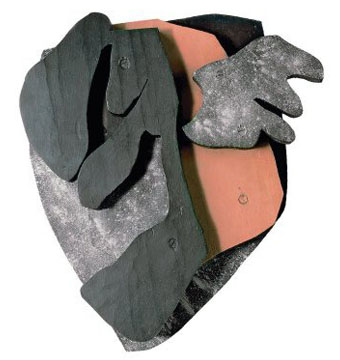
Around the same time, the Dada movement arose. The Dadaist used their art, or what they called “non-art,” to attack the values and conventions held by Western society (here's where we see... "what the heck is that?"). The figure on the right, a piece done by Jean Harriet titled The Embodiment of the Birds and the Butterflies, is a prime example of this movement. It was unusual and questioned the mechanical world Western society had become. The movement didn’t last long, but it led to the Surrealist movement. The Surrealist movement drew from Dada ideologies.
Surrealism wasn’t influenced by Dadaism alone; it was also influenced by Freudian psychoanalysis and the creativity within dreams. Sigmund Freud’s influence pushed boundaries in the world of psychology. He believed that peoples unconscious, their true self, was apparent in their dreams. Dreams held repressed emotions and experiences. Surrealist art, which took a sharp turn away from realism, embodied the importance of Freudian psychoanalysis. Images commonly associated with dreams and the freedom of thought were often seen in abstract Surrealism. Artists were able to expand their creativity during a time of post-war destruction. This was an important phase of Surrealist art: improvising and abstract ideas. The subject of Surrealism was poetic and visionary. Surrealism itself became the poster-name of an entirely new artistic and cultural movement.
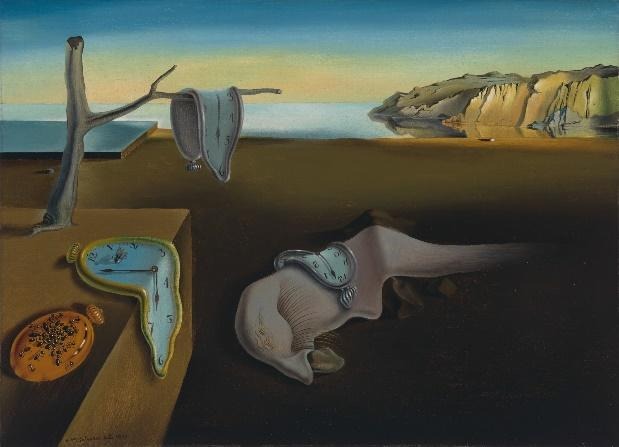
Politics was another influencer of the Surrealist movement. Experimental artists began as Socialists who supported the Communist movement with their work. However, when the Nazi Party started gaining power, many of these same artists started using their work to reveal the truth about the political situation they were living in (my absolute favorite part about art). Salvador Dalí was one of the artists that stayed true to the fascist movement. His paintings are full of color and detail. He is one of the most well-known Surrealists of his time, one who was heavily influenced by Freud. His painting The Persistence of Memory, shown above, captures this influence with fluid watches that symbolize time. His art was well-known, as well as his style. He frequently went to extremes to call attention to both himself and Surrealism. His reputation as an influential Surrealist precedes him.
Before Dalí’s The Persistence of Memory was André Breton’s First Surrealist Manifesto. Written in 1924 by the French poet, the manifesto formally founded Surrealism as an artistic movement and reaffirmed the movement’s interest in liberating the mind from rationality with Freudian psychoanalysis. In his Manifeste du Surréalisme, Breton defined Surrealism as “psychic automatism in its pure state, by which one proposes to express… the actual functioning of thought… in the absence of any control.” The first year of Surrealist painting following the manifesto’s publication focused on the automatism mentioned within. Dalí dominated the art scene with this style of art, shown previously.
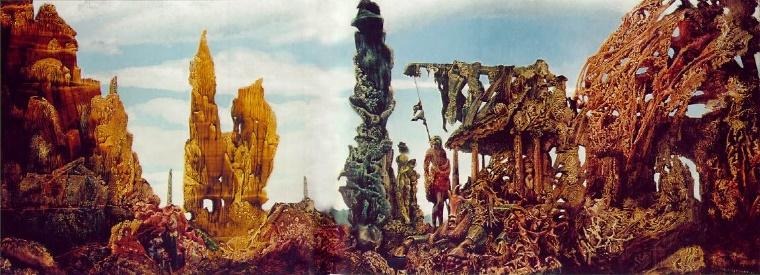
The issue with automatism in art was a lack of method. Automatic drawing, creating a line while in a half-conscious state, was one way to combat this problem. Another solution, which can be seen in Max Ernst’s Europe After the Rain II, shown to the left, was a technique referred to as frottage. Ernst developed this technique of layering paper onto wood. This method created a new effect in art.
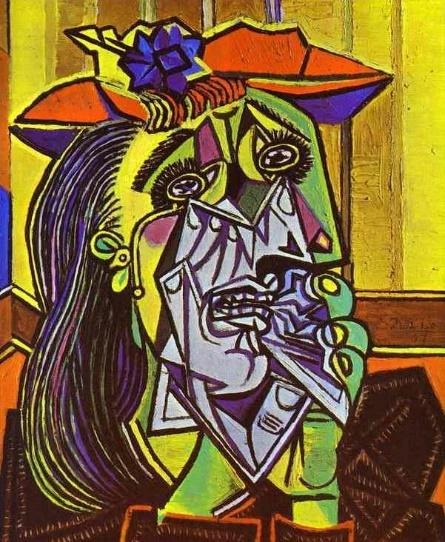
Another well-known artist, Pablo Picasso, was not technically a Surrealist painter. He was, however, a Cubist, which is shown in his piece The Weeping Woman, shown at the right. Cubism focused on geometric shapes and collages. While Cubism and Surrealism are not the same thing, they are connected. Surrealism used Cubism as a point of departure. Surrealism emerged from a restructuring of Cubism, which created an art style that was no longer recognizable as the original form. Cubism developed a new way of creating art that allowed Surrealists to create their own free-thinking art styles. As a Cubist, Picasso was a big part of the Surrealist scene in Paris.
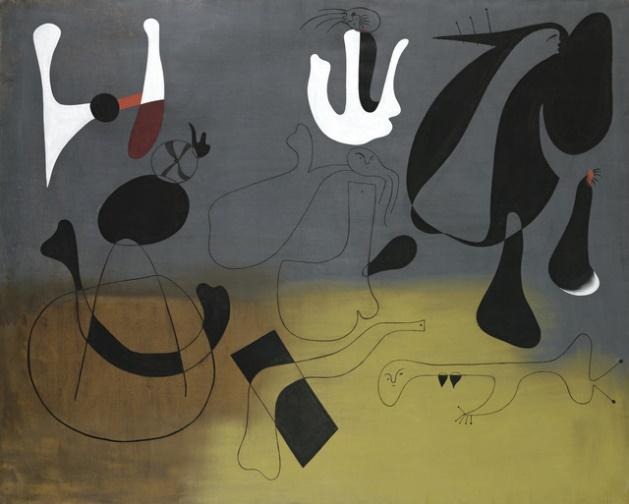
Paris was an important city where Surrealist artists could thrive. Breton founded his Surrealist theology there; he wrote three Surrealist manifestos, a piece in 1928 titled Nadja, and another titled What is Surrealism? in 1934 while living there. Surrealism is actually the French term for “transcending the real.” Joan Miró, a Surrealist who moved to Paris in 1920, adopted André Masson’s “wiry line,” the same kind of line used by Ernst. He used his lines to create geometric shapes in his paintings. His work was extremely abstract. This is seen in his painting Composition, shown to the left. It was made from cut-outs made into a collage. The atmosphere is hazy, and a viewer could take many messages from the artwork. Both the artist and the viewer had to be creative in its making and in its viewing. It is a perfect example of what Surrealism embodied.
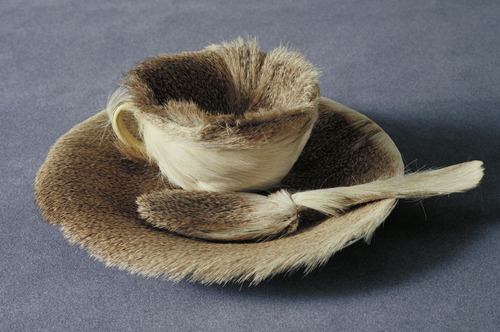
Surrealism wasn’t just painting; it also allowed for objects as art. Artists utilized objects in their art to pursue psychological exploration for themselves and to create the same experiences for viewers. These objects were usually strange and mysterious things to look at. They had no story to go with them, just emotion. They triggered the senses and emotions such as sensuality, desire, anxiety, and despair… all emotions that were prominent in Western society during the early twentieth century. Meret Oppenheim, another artist who lived in Paris, was inspired by a random comment made by Picasso when they were having lunch. She turned it into an artistic object, which can be seen on the previous page. With two-dimensional and three-dimensional art, Surrealism occupied all forms at the time.
With its many influences, Surrealism became a unique and new style of art for the beginning of the twentieth century. They separated themselves from Dadaism to create their own style and borrowed aspects of Cubism to create their art. A huge part of the Surrealist vision stemmed from psychoanalysis of the unconscious and dreams, and, of course, the historical timeline played its own important role in the creation of Surrealism. Politics and the effects of large-scale warfare on society pushed artists to create the work we see in museums today. Surrealist painting, drawing, and sculpture paved the way for new styles of art and welcomed broadened imaginations from artists of the time, and we, decades in the future, benefit from their creation.
Today, in 2026 we are facing political, economic, and social upheaval across the globe. Tensions are high again, and people are tired of the struggle and the hate. While many choose to fear the unknown that will surely come in the next few years, I encourage us all to look at movements like Surrealism to see how resilient the human mind can be. The artists of our generation will certainly create work that makes us ask "what the heck" at first glance but that encourages hope just as their predecessors did.
Oh, and here's some sources if you want to fact check me:
Breton André. Manifeste du Surréalisme. 1910. Translated by A. S. Kline. First Surrealist Manifesto. 2010.
Dupuis, J. F. A Cavalier History of Surrealism. Translated by Donald Nicholson-Smith, AK Press, 2000.
Huntsman, Penny. Thinking About Art: A Thematic Guide to Art History. Wiley Blackwell, AAH, Association of Art Historians, 2016.
Reid, Allison, editor. Surrealist Art in NOMA's Collection. The RosaMary Foundation, 2004.
Rubin, William S. Dada, Surrealism, and Their Heritage. Museum of Modern Art, 1968.
Touborg, Sarah, editor. Janson's Basic History of Western Art. Eighth ed., Pearson Prentice Hall, 2009.
I write a lil something like this usually once or twice a month. Drop your email, and I'll send it straight to you. No newsletter format, no extra spam emails. Just the essay. (Mom this is for you.)